Sunday, 11 January 2015

The interesting buildings of Hankou

China's foreign concessions were territories within China ceded to foreign powers, usually having extraterritoriality - citizens of foreign powers could freely live and trade in them, and they developed their own subcultures distinct from Chinese society.

According to Wikipedia, "some of these concessions eventually had more advanced architecture of each originating culture than most cities back in the countries of the foreign powers origin".

Hankou, one of the three cities which now make up Wuhan, used to have five. The first was the British in 1862, followed by France, Russia, Germany and Japan in 1898. The German one was the first to end in 1917 and the Japanese last following World War 2.


Naturally a walking tour of the area was a must, and several interesting buildings were happened upon.

Here's a shot of the Bund (the road running along the river) c1900 plus a photo taken of the same street today. At time of visit the building on the left which looks like a bank was undergoing refurbishment - a peek inside was briefly possible.


The YMCA appears to still be in use.


This is Hankou's old railway station, DaZhiMen which was the terminus of the Beijing-Hankou Railway, designed by French architects, completed in 1903 and closed in 1991. Was gated at time of visit - not sure of its current use. Postcard is from 1927.


Hankou Orthodox Church on Tianjin Road was built in 1893 and has apparently seen recent major restoration, though there was no access. No date for the postcard.


Finally, a walled-up a building on the Bund. Appears to be a former hotel - though a nearby tourist plaque of the area indicates "Shunfeng Exchange", the characters on the front do spell out 'Long Ocean (something) Hotel'.

Was disappointing not to be able to go in (did ask!) as it's derelict and has some beautiful Streamline Moderne / Art Deco architectural features.


Overall, a brilliant place to go for a wander - only saw some of the area so wouldn't mind a revisit!

Train graveyard, Wuchang, Wuhan

I've several weeks off for the Chinese winter holidays now, so it's a great chance to go out and do some exploring of other parts of the country, and so earlier this week I went to Wuhan, the largest city in central China.

It was while walking up the pedestrian stairwell of the 2nd Yangtze Bridge in the Wuchang area to take a shot of the river when I spotted this accumulation of carriages - further investigation seemed appropriate.


It appears to be a holding area for old railway stock - China's new high speed rail system means many old lines and trains are becoming obsolete.


Sign reads "Protection must be worn before working on the tracks".


One carriage's back door was left open, allowing inspection of this style of long distance train.

Below are the second class seats which is also where standing room only travellers would be packed in. You can imagine it bustling decades ago, reeking of smoke, body odour and Chinese toilet, crying children, caged animals and who knows what everywhere.


There was a cabin with this in in each carriage.


Hard sleeper carriage. These are three-bed bunks - access to the top one would require some physical dexterity.


Dining coach and kitchen


Ticket prices are highest for soft sleeper carriages, which have two sets of more comfortable bunks with a door for privacy.


At this point a man outside started banging on the train and talking in Chinese, so it was time to retreat through the carriage and get out on the opposite side, then under some other trains and extract.

Tuesday, 9 December 2014

Tuesday, 28 October 2014

Changsha Zinc Factory

As Chinese cities expand and build endless flats and shopping and entertainment centres, its older buildings are usually demolished without ceremony.

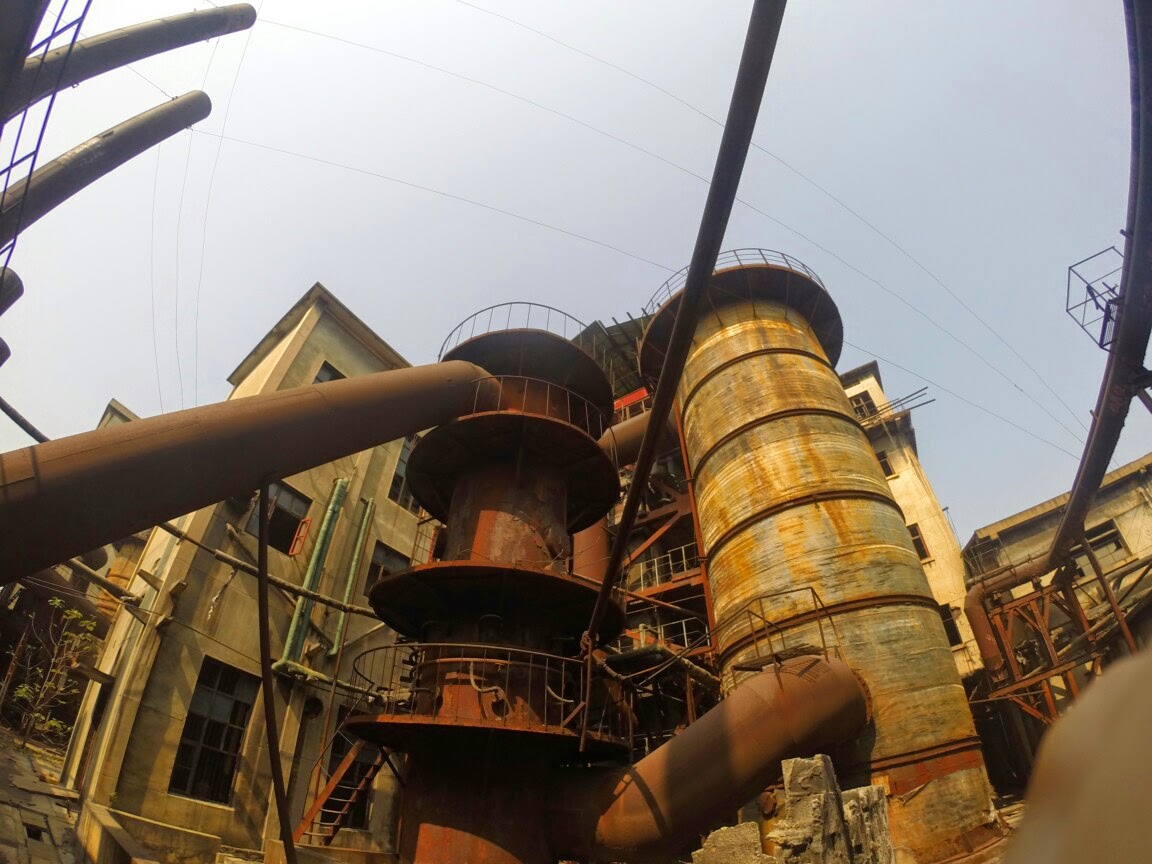
Occasional relics of industrial heritage remain though, including this fantastic factory which I spotted out cycling recently.


Someone helped translate these internal entrance signs - it's Changsha Zinc Company.


China is the world's biggest producer of the stuff, and the smelting process creates significant heavy metal pollution.


Not knowing much Chinese, it's been pretty hard to gain any specific history on the place. The original signs are in traditional Chinese script - mainland China moved to simplified Chinese after 1952 so it must have been built before then. From the state of decay and rust it probably closed well over 20 years ago.

What was found was a whole quarter of abandoned heavy industry - furnaces, tanks, pipes, shafts, silos, stores - all rusting away.

Near the entry point, an old bus next to some workshop/store buildings

En route to the main factory area

This room was beaut.


Raw materials must have come up this shaft into the above room.


Room at the end of the shaft - looks like this is where the material originated.

Approaching the core factory workings

Note the ionizing radioactivity hazard signs - cause for some consternation


Unknown device


Pushed a door which clicked open - this room felt as if it'd not been entered in decades.

Looking back from the far side - water works in the foreground.

Thanks for reading!